News
Namibian MCS officers set the framework for regionally adaptable MCS procedures
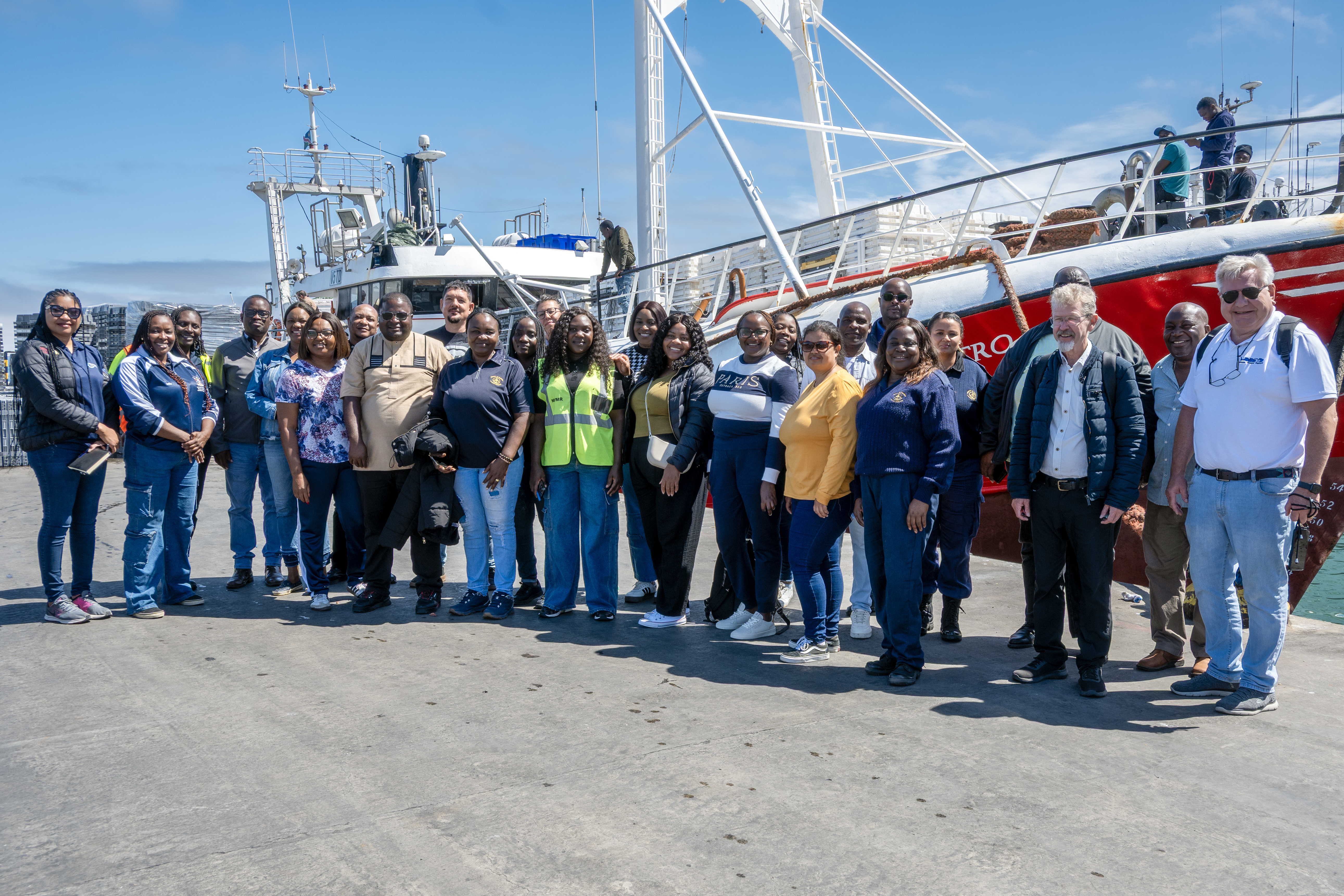
On 23-26 February, 25 MCS officers from Walvis Bay, Lüderitz and MCS managers from Windhoek met in Walvis Bay for the first training session of the Project Strengthening the SADC MCSCC: Focus on Atlantic Coastal States’, in short ‘SADC Atlantic States’.
SADC Atlantic States is supporting fisheries governance in Angola, Namibia and South Africa and helping to scale-up monitoring, control and surveillance (MCS) tools and training across the Southern African Development Community (SADC) region. The Project is building on achievements under the previous Project ‘SADC Atlantic’ of the MCSCC, which ended in September 2025 with a regional workshop during which the Project countries met to agree on concrete operational recommendations for successful MCS regional cooperation through the SADC Monitoring, Control and Surveillance Coordination Centre (MCSCC). Through SADC Atlantic, Namibia developed strong MCS routines in terms of risk assessment of foreign fishing vessels and engagement with other SADC Member States through the MCSCC’s communication platform ‘Basecamp’. Within the three years of the Project, Namibia contributed with Angola and South Africa to one third of all interactions from all SADC countries on the platform and was involved in 33 out of 86 incidents of IUU fishing monitored in the region.
With ‘SADC Atlantic States’, the priority is now on making the next steps to formalise those routines. This includes advancing towards the elaboration of standard operating procedures (SOPs) for risk assessment for foreign fishing vessels coming to port; as well as for inspection, aligned to international best practices.
With this first workshop, Namibia already set the building blocks for the first SOP on processing Advance Requests for Entry into Port (AREPs), a requirement of the Port State Measures Agreement (PSMA) of the Food and Agriculture Organization of the United Nations (FAO) for foreign fishing vessels requesting access to national ports, of which Namibia is a signatory. Those SOPs include detailed guidance to conduct risk assessments and make informed decision based on those AREPs on whether to allow port entry and services to fishing vessels; delay their entry or services; or deny them access to port. A Task Force was constituted to consolidate all inputs gathered during the workshop, finalise and start testing the SOP by the next workshop. Often, SOPs are often too long and complex and end up not being used. The objective of those SOPs is to ensure that they are focussed enough to be implemented.
Risk assessments are an important part of PSMA implementation. They allow to identify risks before foreign fishing come into port. They also provide important intelligence to target inspections, therefore enhancing the efficiency of MCS and capacity to confirm potential violations once on board. An SOP for inspection will be the next step. The participants already identified elements to be included in the SOP – aligned with national legislation and procedures – as well as challenges and needs for implementation. One of the key needs will be to strengthen inter-agency cooperation, in particular with the port authorities (Namport). The results of this workshop will inform further work towards inspection SOPs, in consultation with Namport, to be continued at the next workshop.
Those SOPs are not only important for strong national MCS procedures: they will be useful lessons learnt for the region. Already through SADC Atlantic, Namibia and the other Project countries Angola and South Africa contributed to important regional policy processes, the biggest achievement being the approval of the Code for Establishment of the Regional Register of Fishing Vessels (RRFV) by Ministers in charge of Fisheries in May 2025 in Harare, Zimbabwe. Key provisions of this RRFV Code have been drawn from experience of conducting fishing vessel risk assessments, which the three countries reported through the MCSCC Operational Task Force (OTF) – the technical advisory body of the MCSCC, advising the MCSCC Board of Directors (BoD) on implementation of key services of the MCSCC.
The training also focussed on building capacity of MCS officers to conduct investigations and prosecute offenders when violations are detected. This included practical training for evidence collection during an inspection exercise on board a fishing vessel, as well as taking statements and preparing for court.
This practice is key to build confidence of MCS officers and empower them to act upon law violations. Yet, effective enforcement also requires a strong legal framework, something that Namibia’s Ministry of Agriculture, Fisheries Water and Land Reform (MAFWLR) is aware of. For this, experience and recommendations from actors on the ground, including MCS officers, is key to provide evidence for policy change to better combat IUU fishing.
Changes in the law are needed to adapt to today’s context of the fisheries sector. This includes defining small-scale fisheries actors, who are not recognised due to the lack of definition in the Marine Living Resources Act (MLRA). This workshop highlighted the lack of knowledge of MCS officers about those small-scale fisheries and their efforts to organise to gain recognition and the right to engage in small-scale commercial activities. On the other hand, those fishers also fear MCS officers on the ground. During the following workshop, a sensitisation session will be organised between both small-scale fishers and MCS officers, to enhance awareness of MCS officers about small-scale fisheries, and to support bilateral dialogue.
“MCS officers do not appreciate their work until they come to reflect on the purpose”, said Mr. Beau Tjizoo Deputy Director for MCS at the MAFWLR. “Those trainings remind us of this purpose and help us see that we are an important part of broader regional and global efforts to protect our fisheries”.
Strengthening the SADC MCSCC: Focus on Atlantic Coastal States – is a two-year initiative of the Southern African Development Community (SADC) Monitoring, Control and Surveillance Coordination Centre (MCSCC) which will run from mid-2025 to mid-2027. It is implemented by Stop Illegal Fishing (SIF) and funded by the German Federal Ministry for Economic Cooperation and Development (BMZ) and the European Union via The Deutsche Gesellschaft für Internationale Zusammenarbeit (GIZ), forming part of the GIZ global programme – Sustainable Aquatic Foods – under the Blue Benguela Current Action initiative.